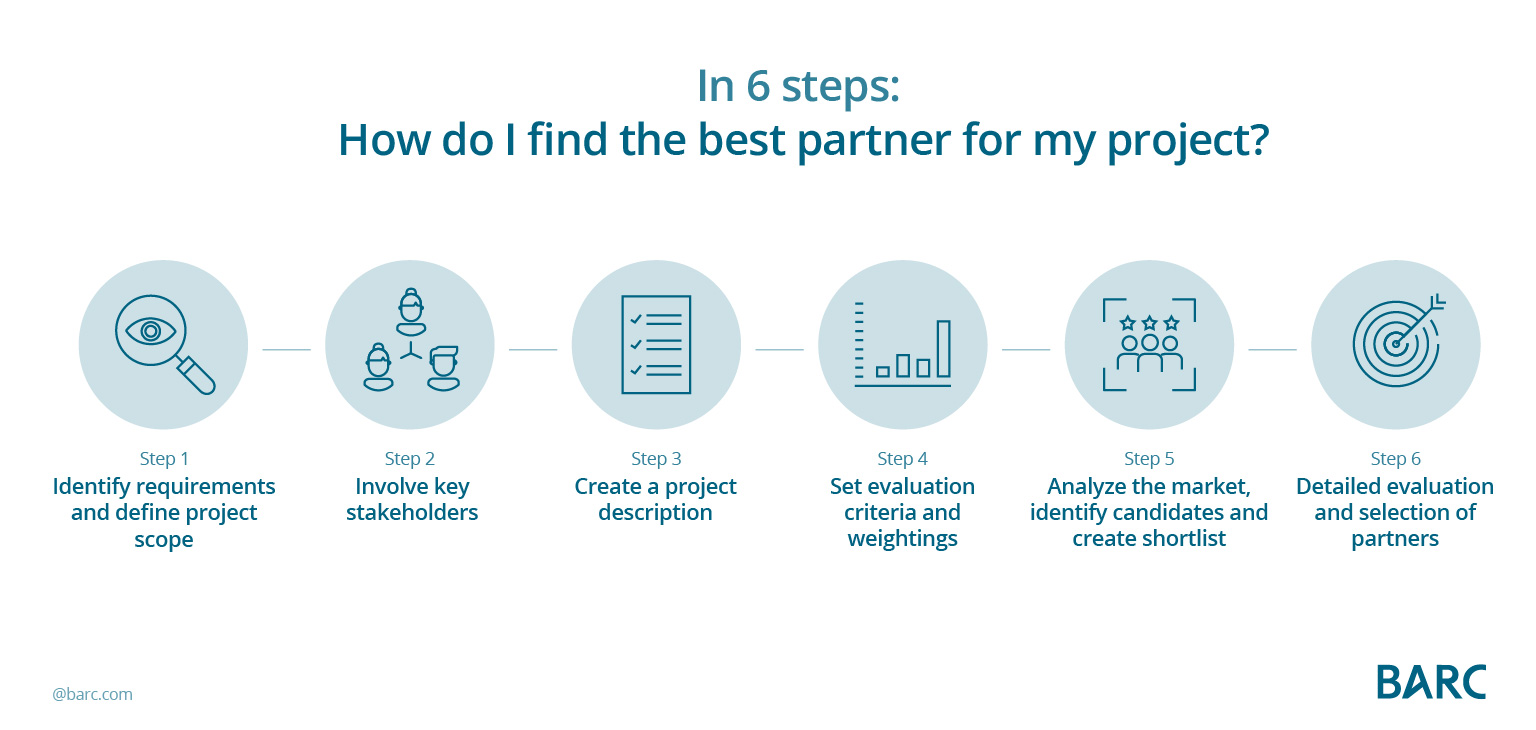
1. Determine requirements and define the project scope
Document all your company-specific requirements and project objectives in a detailed requirements catalog to create a clear, structured, and solid basis for your decision. This catalog should include the following aspects, among others:
What software is already in use at your company, and what is missing? What exactly will the external partner be responsible for, and what specific tasks will be delegated? You should also define the required resources to ensure the partner has the necessary capacity and expertise to successfully complete the project. Also, take into account the geographical region where you need support.
2. Involve key stakeholders early
Make sure to involve all relevant stakeholders at an early stage. In addition to the core team, it’s crucial to include the perspectives of the broadest possible group of stakeholders, such as management and other operational users. These stakeholders shouldn’t just be asked for their requirements; they should be actively kept up-to-date throughout the selection process.
3. Create a project description
Once the project scope and the consultant’s tasks have been defined, they must be documented in detail. This documentation should clearly describe all the services expected from the consultant: From software deployment to implementation activities. This project description creates a framework for better comparison of offers and serves as a guide for the partner to determine project and implementation costs.
4. Define and weight evaluation criteria
Your refined requirements and project description serve as the basis for the rest of the selection process.
The comparison of potential candidates should be based on references, technical and professional expertise, and experience with similar projects. From all your prepared documents, create an evaluation matrix that highlights the differences between candidates. Since no single consulting partner excels in all areas, your core team should carefully weigh which criteria are most important and which are less so.
5. Analyze the market, shortlist, and evaluate candidates
The market for consulting firms is large, with a wide range of specializations and focus areas.
Our extensive internal database, built on over 20 years of practical project experience, provides a solid foundation for this. It offers both a quick overview and the ability to make detailed comparisons.
Use your evaluation criteria to identify 3 to 5 potential partners that best fit your requirements. Obtain the offers and documents you need for your evaluation from these consulting firms. Also, check the references of potential partners, especially concerning their technology, area of expertise, and industry experience.
6. Examine partners in detail and select the best fit
You can assess consulting partners in detail and verify their fit for your company and project by conducting a proof of concept or a “beauty contest.”
The selected partner should be accepted by all relevant stakeholders and decision-makers to ensure a successful collaboration.